Guide4 min read
What a citation chip actually points to
A citation is a pointer to the source behind a sentence, not a guarantee. Learn what to check in the first thirty seconds before you trust an AI answer.
Written by
ChatPEP Team- Published
- Published
A citation in an AI answer is a pointer to the source behind a specific sentence. The chip shows you where a claim came from, not that the claim is true. A useful check is to open the source and look at who was studied, how the study was designed, and how many people or animals were in it.
What a citation is
A citation is a claim about a claim. It says this sentence came from that source. It does not say the source was strong, recent, or relevant to the question you asked. The chip is a label, not a verdict. When an answer places a small number at the end of a sentence, that number links to the source the answer used for that sentence.
The number is there for a reason. It lets you trace the sentence back to the paper, trial record, or page it came from. Without it, you would have to take the answer's word for the claim. With it, you can open the source and decide for yourself.
This habit applies to any AI answer, a search engine summary, or a forum post. A citation tells you where to look. It does not tell you what to conclude.
The thirty-second check
You can size up a source in about thirty seconds. Three details matter most: the population, the design, and the number.
A source can look authoritative and still be a weak match for the question you asked. Before you read the whole paper, check three things in the title and abstract.
- Check the population. Look for words like 'healthy adults', 'rats', or 'cell culture'. A human trial and a rat study point to very different kinds of evidence.
- Check the design. See whether the source describes a randomized trial, an observational study, a review, or a lab experiment. The design sets the limit on what the finding can support.
- Check the number. A study of 12 people is a signal, not a settled finding. A study of 1,200 people carries more weight, but only when the design and population fit the question.
One detail does not settle the matter. A large human trial can still be flawed. A small animal study can still point toward a useful question. The thirty-second check is a filter, not a final judgment.
Where ChatPEP points
ChatPEP cites three kinds of sources: published studies, registered clinical trials, and web pages 1. Each kind points to a different place, so the chip tells you what to expect before you open it.
Published studies are linked on PubMed, a database of biomedical research, or by their DOI, a permanent link to a specific paper. Registered clinical trials are linked on ClinicalTrials.gov. Web pages are linked by their address 1. Citation numbers appear as small chips at the ends of sentences in the answer 2.
Sources are part of any ChatPEP answer. On all plans, ChatPEP draws from its library of peptide research and current sources from the web 1. Under each answer, a Sources button shows how many sources the answer used. Select it to open the full list 1.
Opening a citation chip
The answer view shows numbered citations in the text and a source list under it. Opening a chip is the fastest way to see the source behind a claim.
On the web, select the number at the end of a sentence. A panel opens with the numbered sources, and the sources behind that sentence are highlighted 1. Each source shows where it is published, its title, and its authors and year. Select one to open it in a new tab.
On iPhone and on Android, tap the number at the end of a sentence. The Sources sheet opens with the sources behind that sentence highlighted. Tap a source to open it in the in-app browser 1.
The screen below shows an answer with numbered citations in the text and the source list under it.
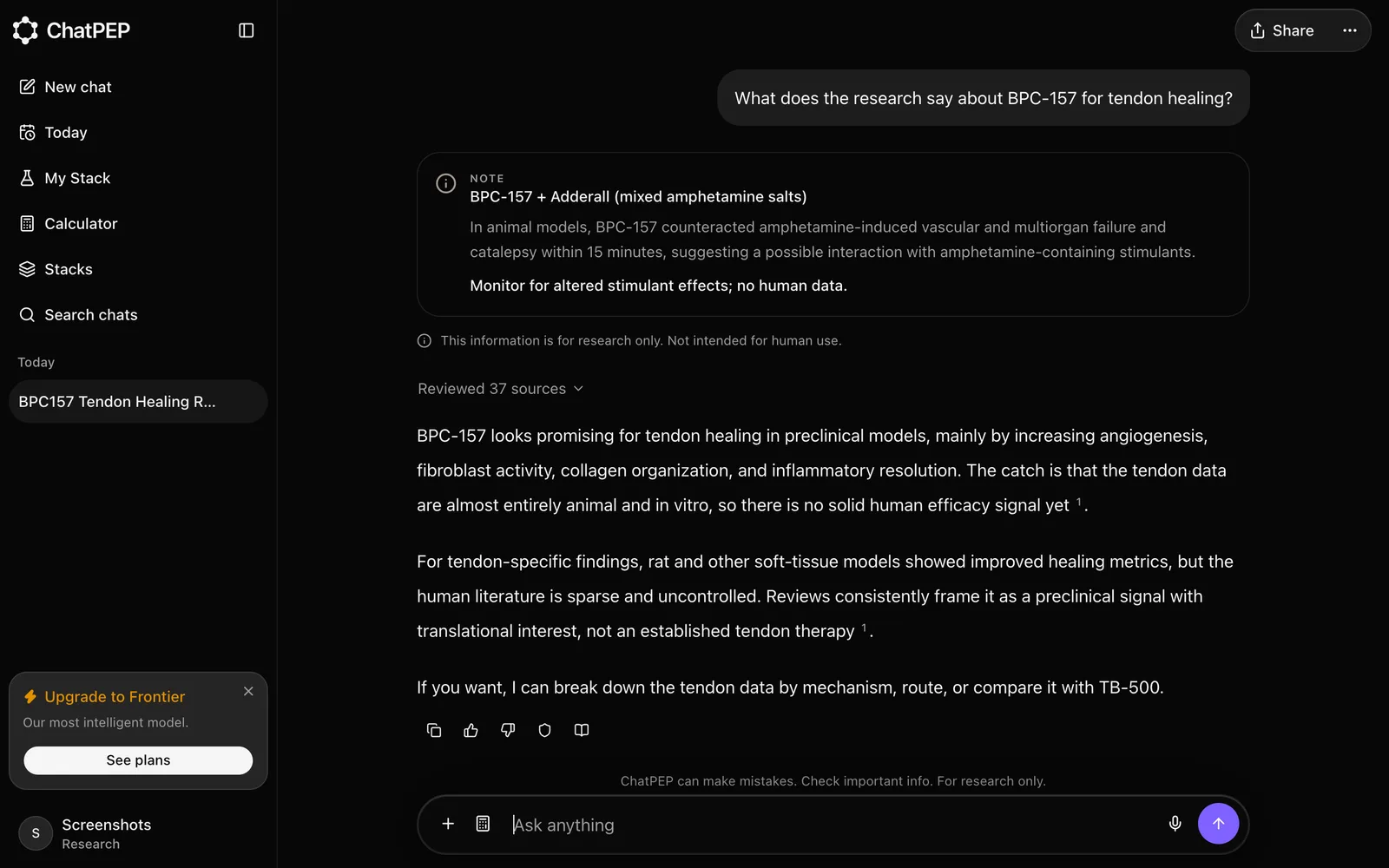
The number is the door. The panel is the hallway. The source list is where you stop and read.
When a citation is missing
Not every sentence has a citation. Definitions, general explanations, and follow-ups on something already cited may have none 1. That is expected, but it changes how you should read the sentence.
A sentence with no citation is not automatically wrong. It may be a definition or a restatement of an earlier point. But if it makes a factual claim you want to rely on, ask for the evidence. A direct question such as 'Which studies show that?' asks the answer to cite its source 1.
A citation can also be present and still be wrong. ChatPEP can make mistakes, including citing a source that does not fully support a claim 1. For anything important, open the source and read it. If a citation does not match the sentence, rate the answer with a thumbs down or report it 1.
When to skip this guide
- You want a source that guarantees a claim is true. A citation points to the source, but you still need to open it and read it 1.
- You want every sentence cited. Definitions and general explanations may have no citation, and that is expected 1.
- You want an answer you do not need to check. ChatPEP can make mistakes, including citing a source that does not fully support a claim 1.
- You want a rating to change the answer you saw. A rating is recorded, but it does not change that answer 3.
References
Judge a study or a citation
ChatPEP answers from the studies, with every source cited, and never tells you what to take.
Keep reading
Guide6 min read
How to tell a rat study from a human trial
Most headlines about a peptide hide the species behind the finding. Learn to spot whether a claim rests on a rat study or a human trial, and what each level of evidence can and cannot tell you.
Guide5 min read
Asking a follow-up that narrows an answer
A broad question gets a broad answer. The second question is where you choose the population, outcome, or study design.
Guide4 min read
How to research a peptide for recovery without guessing
A plain walkthrough for checking what has been studied for a recovery goal, in whom, with what results, and where the evidence thins out.