Guide4 min read
How to research a peptide for recovery without guessing
A plain walkthrough for checking what has been studied for a recovery goal, in whom, with what results, and where the evidence thins out.
Written by
ChatPEP Team- Published
- Published
Recovery is a broad word. A peptide (a short chain of amino acids) that helped close a skin wound in rats tells you little about tendon repair in people unless you trace the studies. The way to research it without guessing is to follow a chain of questions from the goal to the evidence.
Start with the goal, not a peptide
Begin by naming the tissue or system you want to recover, and the event it is recovering from. Recovery is not one thing: a tendon strain, a surgical wound, a muscle tear, and a nerve injury are different problems with different studies behind them.
Run the goal through three questions before you search:
- What tissue or system is recovering? Tendon, skin, muscle, nerve, and gut lining are different problems.
- What event caused the damage? A strain, surgery, wound, or training load changes the evidence you need.
- What change would count as recovery? Reduced pain, regained strength, closed wound area, or something else you can name.
Why this matters: a claim like "supports recovery" is too vague to check. A tool that lets you start with a vague goal will return vague results. A useful research tool pushes you toward a sharper question.
What has been studied
Second, ask which compounds have been studied for the specific recovery goal you named, not which compounds are popular for recovery in general. Two questions sound similar but lead to different answers.
| If you ask | You get |
|---|---|
| "What peptides help recovery?" | A list of names, often with no study attached to the tissue you care about |
| "Which peptides have been studied for tendon repair after injury?" | A narrower set with studies you can check |
This information is for research only. Not intended for human use.
A search engine ranks pages. A research tool should rank by evidence, not by how often a peptide is mentioned. Test any tool by asking the sharper version of your question and checking whether the answer names studies.
Check who was studied
Third, find out whether each study used cells, animals, or people. This is the single quickest way to judge a recovery claim.
| Study type | What it can show | What it cannot show |
|---|---|---|
| Cells in a dish | Whether a peptide did something to cells | Whether that happens in a living body |
| Mice or rats | Whether an effect appears in a whole animal | Whether people show the same effect |
| Human trial | Whether an effect showed up in people | Whether it will appear for any one person |
This information is for research only. Not intended for human use.
Why this matters: recovery claims that sound strong often come from animal or lab work. That does not make the finding false. It makes it early. A useful tool labels the evidence level instead of blending all studies together.
What the studies measured
Fourth, look for what the study measured as a result. A study can measure pain, strength, tissue size on a scan, or time to return to activity. A study that only measured a blood marker is different from one that measured whether a wound closed.
Ask whether the result was large enough to matter, and how long it lasted. A short-term change in a lab measure is not the same as a lasting change in how a tissue functions.
A useful tool says what was measured, in whom, and for how long. If an answer repeats that a peptide is "known for recovery" but cannot point to a measured result, keep looking.
A research tool built for this chain
ChatPEP is a research tool for peptides. It is set up to follow this chain when you ask a question. It tells you whether a finding comes from human trials or from animal and lab studies, and it says how strong the evidence is 1. It cites the study behind a sentence, so you can open the source and check it 2.
When you ask how a compound was studied, ChatPEP can show a studied protocol card (a card that shows how a compound was dosed in one named source) with the source named. It describes doses as studies used them rather than turning them into instructions for you 3. Ask a question that names the goal and the tissue, such as "Which peptides have been studied for tendon repair after injury?" ChatPEP answers with the point first, then the caveats 1. Most answers end with a related follow-up question, like how long those studies ran or which side effects were reported 6.
How to read the answer it gives
On the web, the answer screen shows ChatPEP's written answer with small citation numbers at the ends of sentences, and a Sources button under the answer. The source list under the answer gives each source's authors, title, and where it was published 1.
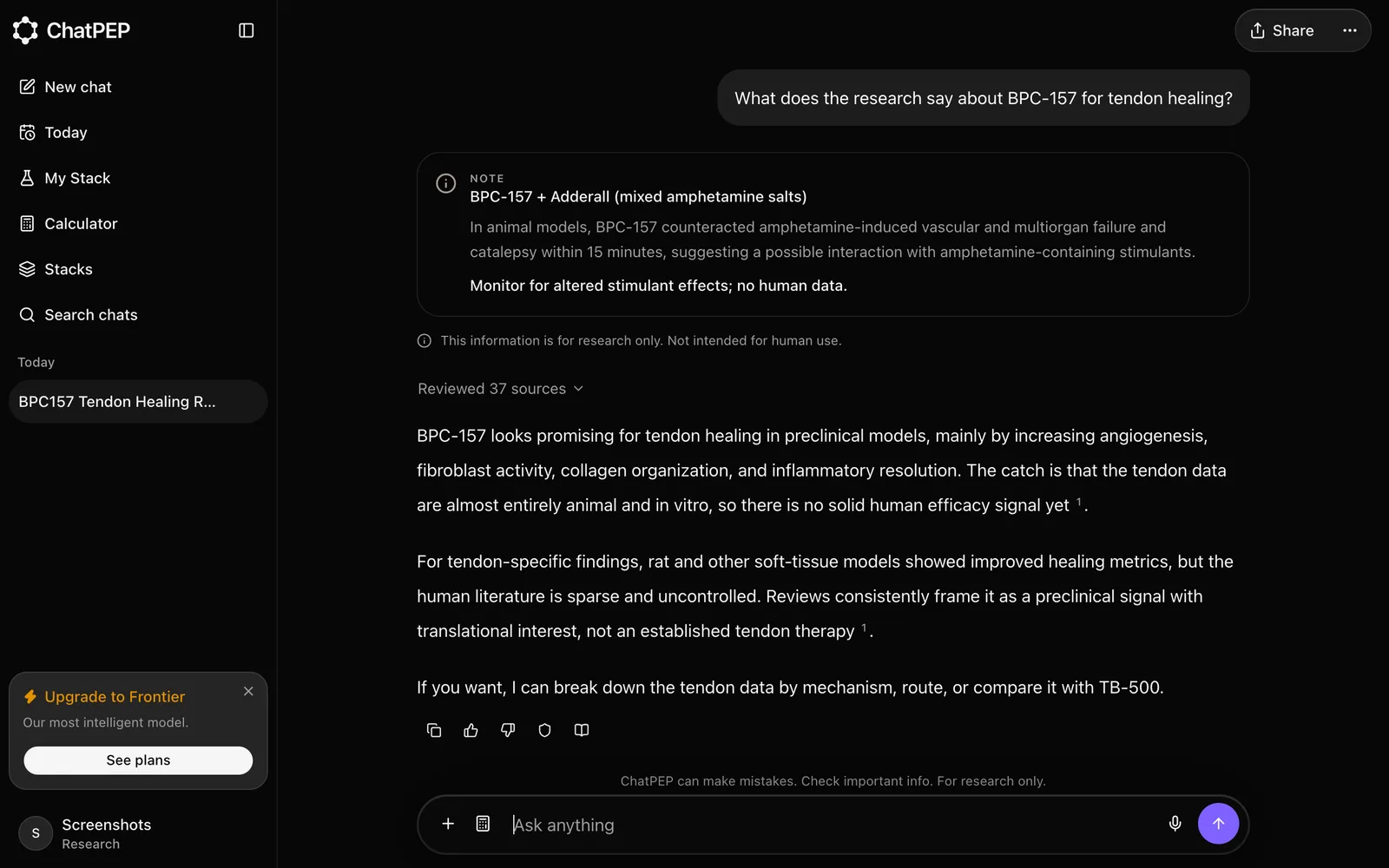
Select a citation number to see the source behind that sentence, or open the full source list from the Sources button 2. If the answer includes a studied protocol card, check the source line and the population it was studied in, and remember the card is a summary of the research, not a plan for you 3. Use the buttons under the answer to copy 1, rate, or report a concern 7.
If an answer looks wrong, open the source and read it. You can rate the answer or report a safety concern so the team can look at it 7.
Who this is not for
- You want someone to tell you exactly what to take, how much, and when. ChatPEP does not do that. It describes what studies used, not what you should take 4.
- You want a diagnosis or treatment plan from a chatbot. ChatPEP is not medical advice 8.
- You want a free tool with no limit on daily questions. The free plan includes 5 messages a day 9.
- You want an answer with no source-checking expectation. ChatPEP expects you to open the citations and check important information 1.
Compound pages
References
- 1.How to read an answerChatPEP Help Center · 2026
- 2.Sources and citationsChatPEP Help Center · 2026
- 3.Studied protocol cards, and what they are notChatPEP Help Center · 2026
- 4.Research only: what that meansChatPEP Help Center · 2026
- 5.Ask your first questionChatPEP Help Center · 2026
- 6.Suggested follow-up questionsChatPEP Help Center · 2026
- 7.Rate an answerChatPEP Help Center · 2026
- 8.ChatPEP is not medical adviceChatPEP Help Center · 2026
- 9.Message limits and when they resetChatPEP Help Center · 2026
Do a research task with an AI tool
ChatPEP answers from the studies, with every source cited, and never tells you what to take.
Keep reading
Guide6 min read
How to tell a rat study from a human trial
Most headlines about a peptide hide the species behind the finding. Learn to spot whether a claim rests on a rat study or a human trial, and what each level of evidence can and cannot tell you.
Guide5 min read
Asking a follow-up that narrows an answer
A broad question gets a broad answer. The second question is where you choose the population, outcome, or study design.
Guide4 min read
What a reconstitution result shows, and what it leaves out
A reconstitution calculator converts vial size, water, and an entered amount into concentration, units, and doses per vial. This guide explains what each result line means and what the math leaves out.