Guide4 min read
What a reconstitution result shows, and what it leaves out
A reconstitution calculator converts vial size, water, and an entered amount into concentration, units, and doses per vial. This guide explains what each result line means and what the math leaves out.
Written by
ChatPEP Team- Published
- Published
- Updated
- Updated
A reconstitution calculator result (after water is added to a vial) turns the three numbers you enter into the answers you need to match a vial to a syringe. It shows how concentrated the liquid is, how many units hold a given amount, and how many times that amount fits in the vial. That is arithmetic, not a recommendation.
What does the result actually show?
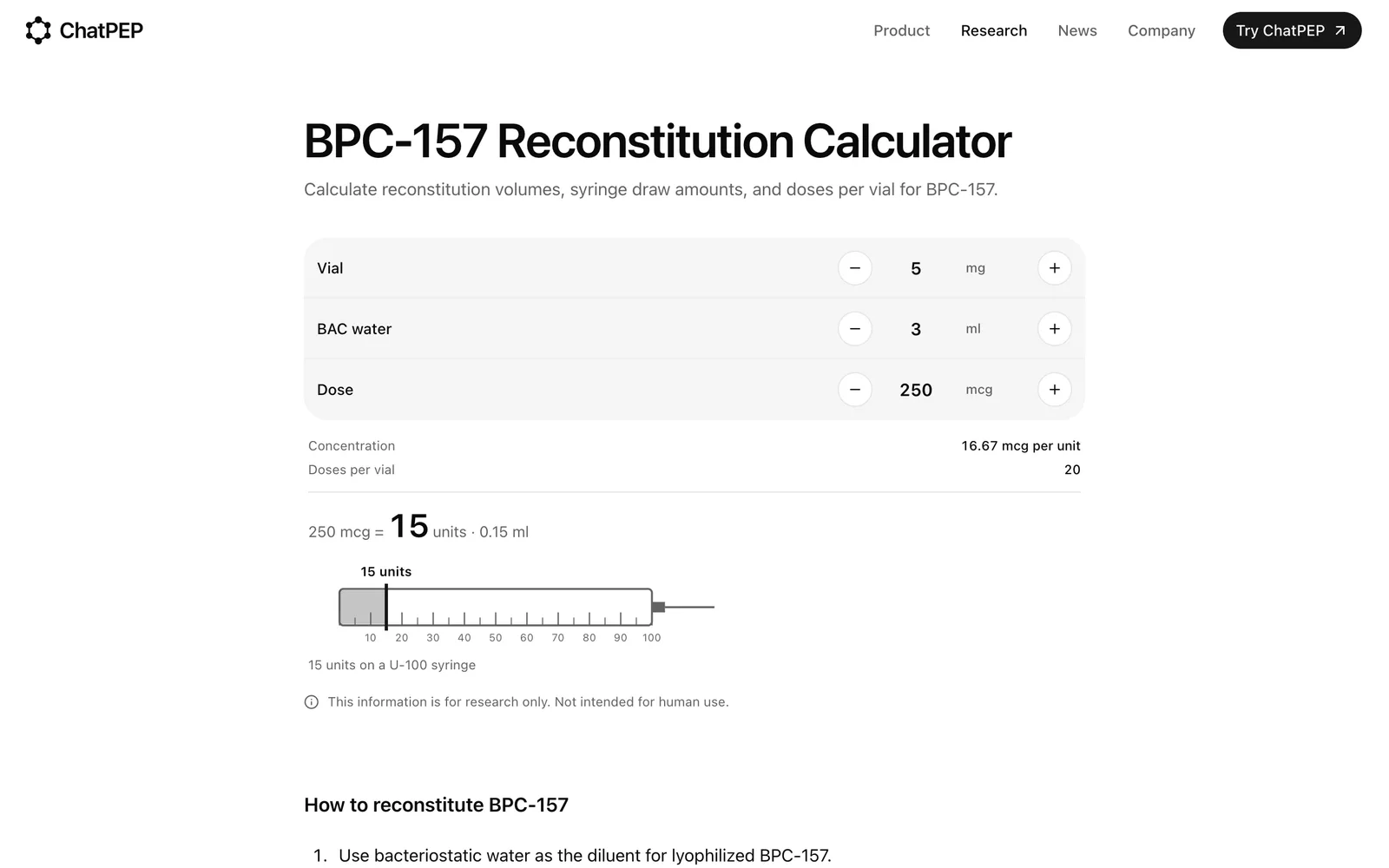
A typical result has three lines: concentration, the amount in units and milliliters, and doses per vial. Concentration is how much of the compound sits in one syringe unit. The large number is how many units hold the amount you entered, with the same volume in ml. Doses per vial is how many times that amount fits in the vial, rounded down to a whole number.
Here is a worked example with a 10 mg vial, 2 ml of water added, and 1,000 mcg entered.
| Line | What it means | Example |
|---|---|---|
| Concentration | amount in one syringe unit | 50 mcg per unit |
| Units for amount | how many marks hold the entered amount | 20 units, or 0.2 ml |
| Doses per vial | how many times the amount fits | 10 |
This information is for research only. Not intended for human use.
The math goes like this: 10 mg is 10,000 mcg. Two ml of water makes 200 units on a 100-unit syringe scale, because each ml is 100 units. Dividing 10,000 mcg by 200 units gives 50 mcg per unit. Dividing the 1,000 mcg amount by 50 gives 20 units, or 0.2 ml. The vial contains 1,000 mcg ten times.
Why does the syringe number matter?
The unit number is the part that helps you line up a real syringe. A 100-unit insulin syringe has 100 marks per ml, so 20 units is the same as 0.2 ml. If the result shows a different unit number, that tells you where the 0.2 ml mark sits. This matters because a syringe is marked in units, not always in milliliters.
The calculator assumes a 100-unit syringe scale, where 100 units equal 1 ml 1. If you use a different syringe, the unit mark will not match, even though the volume in ml is the same. The ml line is the same number in any syringe; the unit line refers to a 100-unit scale.
Where does ChatPEP show this?
ChatPEP puts the same arithmetic inside its reconstitution calculator. You can open it from the message box, from the sidebar, or inside an answer when ChatPEP has worked out the math for you. 1
When the answer includes a calculation, the result appears with the written answer. You can change the numbers right there and see the result update. The calculator does not suggest an amount; it converts the numbers you type. 1
What does the calculator not know?
A reconstitution result is as accurate as the numbers you enter. The calculator does not see the vial label, so a mistyped mg or ml number flows all the way through. It does not check whether the amount makes sense for a particular research context, and it does not tell anyone what to take. 1
It also does not know the syringe you own. It assumes a 100-unit syringe scale. If a syringe has a different scale, the unit number needs a second look, though the ml number stays the same. 1
The calculator has no field for a person's health history, medications, or goals, and it cannot weigh them. Those are matters for a qualified clinician, not for a field that turns mg and ml into units. 2
What if the result looks wrong?
First, check the three numbers you entered against the vial label and the water amount. A calculator result is as accurate as those numbers. 1
Switching between mcg, mg, and IU can reset the fields to starting values, so check all three after you switch. 1
On the web, the calculator can handle a blend vial. For each component, it shows the share, the mcg per unit, and the amount in a draw. If the result says two targets need different unit numbers, the calculator will note that, because one draw cannot match both. 3 On iPhone, a blend answer shows a summary card instead of the full breakdown. 3
Who this is not for
This guide is not for every situation.
- It is not for anyone looking for a suggested amount. ChatPEP does not tell anyone what to take, how much, or how. 4
- It is not for someone using a syringe that is not a 100-unit scale, unless they are comfortable checking the ml line instead. The calculator counts on a 100-unit syringe scale. 1
- It is not for someone who wants a tool to judge a vial or a protocol. The calculator works with the numbers you enter, and it cannot check whether the vial label is correct or whether an amount is appropriate. 1
- It is not for a medical decision. ChatPEP is not medical advice, and it cannot take the place of a clinician who knows your history and can examine you. 2
References
Get a reconstitution number right
ChatPEP answers from the studies, with every source cited, and never tells you what to take.
Keep reading
Guide6 min read
How to tell a rat study from a human trial
Most headlines about a peptide hide the species behind the finding. Learn to spot whether a claim rests on a rat study or a human trial, and what each level of evidence can and cannot tell you.
Guide5 min read
Asking a follow-up that narrows an answer
A broad question gets a broad answer. The second question is where you choose the population, outcome, or study design.
Guide4 min read
How to research a peptide for recovery without guessing
A plain walkthrough for checking what has been studied for a recovery goal, in whom, with what results, and where the evidence thins out.