Guide5 min read
How to research peptides in your own language
Most peptide studies are published in English, but a research tool should answer in the language you write in. This guide explains how to check what a translated answer gets right, and what to do when a citation and a translation disagree.
Written by
ChatPEP Team- Published
- Published
Most published peptide research appears in English, but you do not have to read it in English to work with it. You can ask a research tool a question in your own language and still check the study behind the answer. The work is knowing what a translated answer should preserve, and what you need to open the original source for.
What a translated answer should preserve
A useful answer in your language keeps the meaning of the study and keeps a clear way back to the original paper. You are not just reading a summary. You are reading a claim that is supposed to be tied to evidence, so check that the translation did not quietly change the evidence.
A translated answer should preserve compound names, study types, and units. For example, a study in mice should still be a study in mice, not a human trial. A milligram in the original should not become a microgram in the summary. A compound name such as BPC-157 should stay recognizable, because similar names can describe different peptides.
The answer should also preserve uncertainty. Research language often uses careful verbs like suggested or found an association. A loose translation can turn that into proved or showed. When an answer in your language sounds stronger than the research would support, that is a reason to slow down.
A translated answer should also preserve the type of evidence. A lab study on cells, a study in rats, and a human trial carry different weight. If the original says cells and the answer says humans, the answer has changed the meaning even if the rest of the sentence looks correct.
How to check a translated claim
The fastest check is to compare the claim with the source it cites, not with the translation alone. That check works the same in any language.
- Open the citation beside the sentence. A numbered citation should show the study it comes from.
- Look at the original title and abstract, even if you need a browser translation for those few paragraphs.
- Check the study type. Does the answer say humans when the source used rats or cells? That gap matters.
- Check the direction of the finding. Did the source report an effect, a lack of effect, or a suggestion?
- Check the numbers and units if the answer includes any. A small unit error changes the meaning.
If the original paper is in English, you do not need to read all of it. You need enough of the abstract or source page to confirm the claim, not the whole paper. The point is not to become a translator. The point is to catch a mismatch before you rely on it.
A translation can be fluent and still be wrong. Fluency tells you the language is readable, not that the science is intact. The source is the place where the science is intact.
How ChatPEP handles your language
ChatPEP answers in the language you write your question in. Ask in Spanish and the answer comes back in Spanish. If you switch languages partway through a chat, ChatPEP switches with you 1. The Language setting in the app does not set the answer language. It sets the units your height and weight are shown in 2. This means you do not have to find a translation mode or turn anything on before you ask.
When ChatPEP answers, the written answer carries small numbered citations at the end of sentences, and a Sources button beneath the answer lists every source used 3. On the answer screen, you can select a number to see where that sentence came from. The source behind that sentence is highlighted, and you can open it in a new tab 3.
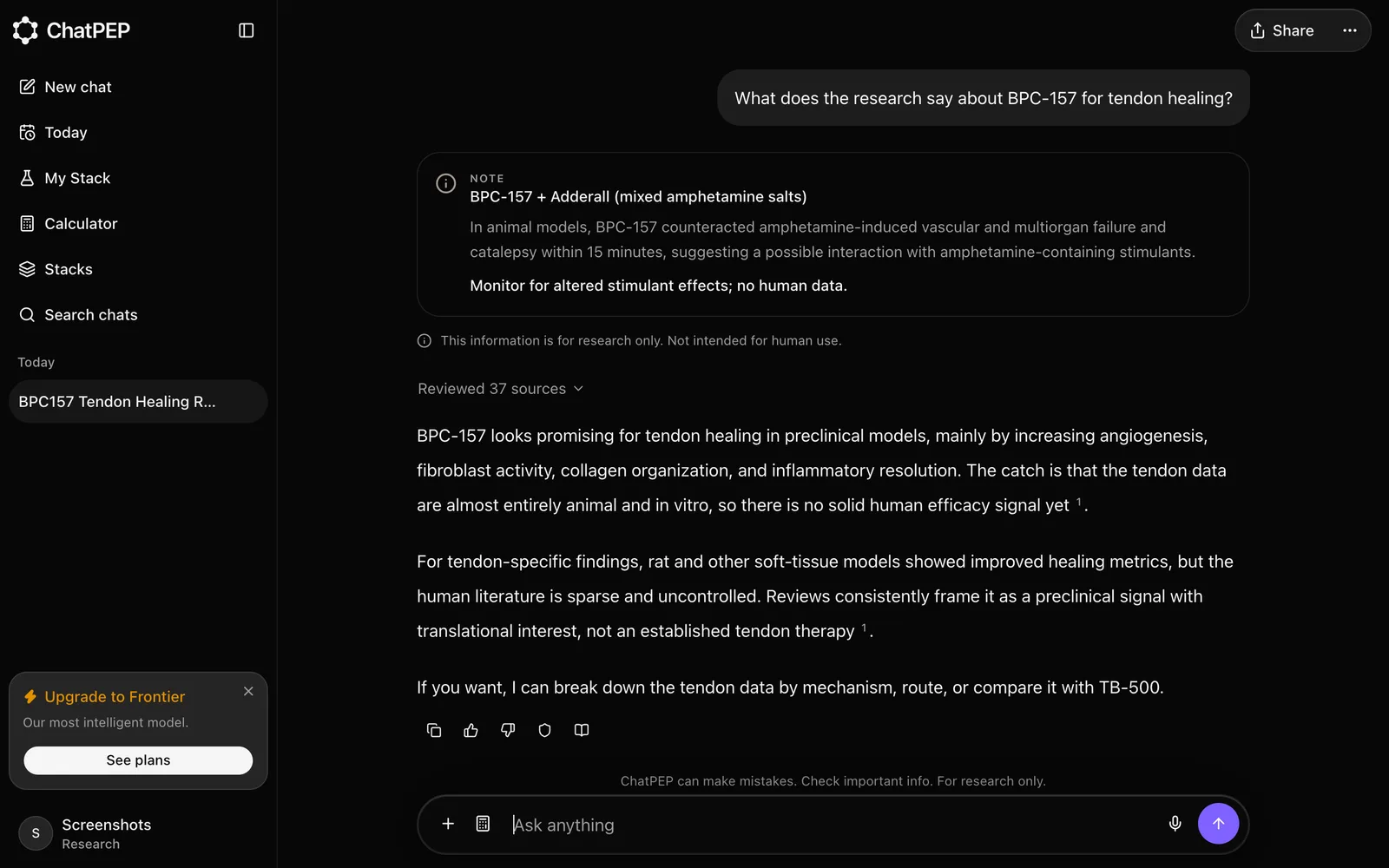
The answer screen shows what to expect. The text appears in your language, numbered citations sit in line, and the source list sits under the answer. The source list is where you go when the translation and the source need to be checked.
What stays in English is also stated clearly. Menus, buttons, settings, suggested questions, and emails remain in English. The cited sources are usually in English, and citations open the original source rather than a translated copy 1. That is not a flaw to hide. It is exactly why the source check matters.
If you ask a question in one language and the answer comes back in another, you can ask ChatPEP to answer in your language. Compound names and units stay as they appear in the research 1.
A worked example in Spanish
Suppose you ask in Spanish what the research says about BPC-157 and recovery. The answer comes back in Spanish, and beside one sentence there is a numbered citation. You select the number and see a study in English.
You do not need to read the full paper. You look for three things in the source page: the animal or human model, the direction of the finding, and the units. If the Spanish answer says the study was in rats and the source says rats, they match on that point. If the Spanish answer says the study was in humans and the source says rats, you have found a mismatch.
The same check works for direction. If the source describes a suggestion and the answer describes a proof, that is a mismatch. If the source lists a dose in milligrams and the answer lists micrograms, that is a mismatch. The exact study result matters less for this example than the practice of comparing the answer with the source before relying on it.
This is not about being fluent in English. It is about knowing which three things to compare. A browser translation of the abstract can be enough for those three checks.
When the answer and the source disagree
A disagreement does not mean the whole answer is useless. It means that one claim needs more checking, and the source is the more reliable place to look.
Start by reading the original abstract or web page. If the source does not support the sentence, paste the source link into your message and ask whether it actually says that; ChatPEP reads the page and can answer again 3. If the answer is still wrong, use the thumbs down or report a safety concern if it could mislead someone 4.
A bad citation is a reason to check that claim, not a reason to disregard the whole tool. The same rule applies to a general chatbot or a search engine.
If the mismatch involves a safety concern, such as a dose that looks wrong, use the safety reporting path rather than waiting. Reporting an inaccurate or misleading answer is separate from a thumbs down 4.
Who this is not for
- You want the menus, settings, suggested questions, and emails in your language too. They stay in English, and the Language setting changes measurement units, not answer language 1.
- You plan to dictate questions in Spanish or another language from the iPhone or Android app. App dictation listens in English (US), so typing the question in your language is the reliable path 5.
- You expect cited sources to open as a translation. Citations open the original sources, which are usually in English 1.
- You want the free plan to review published scientific papers in depth. Published scientific papers are reviewed on the Research and Frontier plans, not on the free plan 6.
References
Do a research task with an AI tool
ChatPEP answers from the studies, with every source cited, and never tells you what to take.
Keep reading
Guide3 min read
What happens when you upload a study or report
What an uploaded PDF or photo can and cannot do for a research question: extraction, what is kept, what is discarded, and why a summary is not a source.

Studies5 min read
Stroke data tie Cerebrolysin to better cognition after prior decline
A new analysis of the C-REGS2 stroke study found that Cerebrolysin was linked to better 90-day cognition, with the largest gains in people who had cognitive decline before their stroke.
Guide6 min read
How to tell a rat study from a human trial
Most headlines about a peptide hide the species behind the finding. Learn to spot whether a claim rests on a rat study or a human trial, and what each level of evidence can and cannot tell you.