Guide3 min read
What to look for in a research tool for peptides
Six tests any research tool should pass before you trust it: it shows the study, states the evidence level, reports doses without advising, checks your medications, does the math, and remembers what you are researching.
Written by
ChatPEP Team- Published
- Published
- Updated
- Updated
A research tool for peptides has one job: tell you what the studies found, in a way you can check. Six tests separate a tool that does that from one that only sounds like it does. Run them on anything before you trust it, and run them on the one that wrote this page.
1. It shows the study
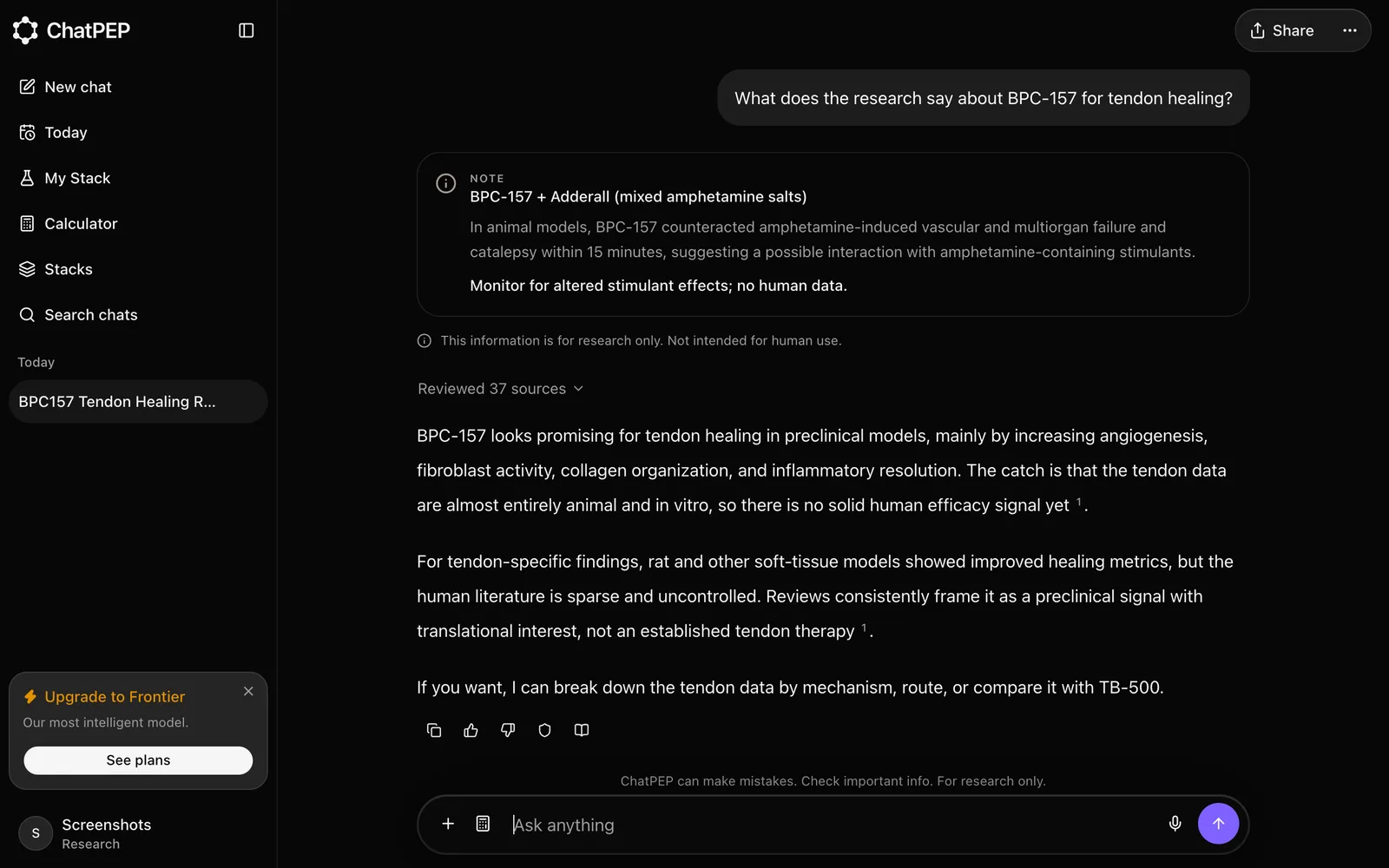
Ask for the source of one claim. A good answer names the study it came from and lets you open it. That is not decoration. A claim you cannot trace is an opinion, however fluently it is written, and fluency is the easiest thing for software to fake. A tool passes this test when the claims that carry evidence point at a paper, a trial record, or a page you can read yourself1.
2. It states the evidence level
Ask whether the finding is from people, animals, or cells. ChatPEP says how strong the evidence is, including whether a finding comes from human trials or only from animal and lab studies2. A tool that presents the two at the same volume is misleading you even when every sentence is true. It passes when the evidence level sits beside the finding, every time, without being asked.
3. It reports doses without advising
Ask how a compound was dosed. The research half of that question has a real answer: what a trial or a published protocol used, phase by phase, with the source named. The advice half does not, because a tool does not know you and the research does not say. A good tool answers the first in full and stops before the second. ChatPEP draws that line on purpose: a studied protocol card lays out the schedule a named source used, and the personal recommendation is the part it never adds3.
4. It checks your medications
Tell it about a medication and ask about a compound. A tool passes when it raises the interaction on its own, names the pair, and says what is known about it, so the warning is something you can weigh rather than a verdict you are asked to accept5.
5. It does the arithmetic
Give it a vial, the amount of liquid you add to it, and a dose. Working out the concentration once that liquid is mixed with the powder, called reconstitution math, is one formula, and it is easy to get wrong by a factor of ten. A research tool should compute it and show the working, not estimate it in prose. If the number comes back without the steps, do it by hand and compare.
6. It remembers what you are researching
Ask a second question. Research is a sequence of narrowing questions, and a tool that forgets the first one makes you start over each time. It passes when your goals, your experience level, and the compounds you are looking into shape the next answer without being restated.
How ChatPEP measures up
ChatPEP is built around tests one through four: cited answers, the evidence level stated, studied protocols reported with their source and without advice, and interaction warnings drawn from your profile. Not every sentence carries a citation: definitions, general explanations, and follow-ups on something already cited may have none, and asking "Which studies show that?" brings up the evidence1. A reconstitution calculator works out the concentration and volume for a vial, your goals and experience level shape the answers you get, and My Stack keeps track of the compounds you are researching2. The free plan includes 5 messages a day, which is enough to run every test on this page6. Two honest limits: it answers questions about peptides and the research around them and declines anything else, and it can be wrong, which is why the sources are there to open2.
Who this is not for
- Anyone who wants to be told what to take. ChatPEP will lay out how a compound was dosed in a named study or published protocol, with its source, and it stops there: it does not turn that into a recommendation for you4.
- Anyone who needs medical advice. It does not diagnose, treat, or prescribe, and a healthcare provider is the right person for a decision about your health7.
- Anyone with a question outside peptides and their research. It answers on that subject and declines the rest2.
References
- 1.Sources and citationsChatPEP Help Center · 2026
- 2.What ChatPEP is, and what it is notChatPEP Help Center · 2026
- 3.Research only: what that meansChatPEP Help Center · 2026
- 4.Studied protocol cards, and what they are notChatPEP Help Center · 2026
- 5.Interaction warningsChatPEP Help Center · 2026
- 6.Compare plansChatPEP Help Center · 2026
- 7.ChatPEP is not medical adviceChatPEP Help Center · 2026
Decide what kind of research tool to trust
ChatPEP answers from the studies, with every source cited, and never tells you what to take.
Keep reading
Guide6 min read
How to tell a rat study from a human trial
Most headlines about a peptide hide the species behind the finding. Learn to spot whether a claim rests on a rat study or a human trial, and what each level of evidence can and cannot tell you.
Guide5 min read
Asking a follow-up that narrows an answer
A broad question gets a broad answer. The second question is where you choose the population, outcome, or study design.
Guide4 min read
How to research a peptide for recovery without guessing
A plain walkthrough for checking what has been studied for a recovery goal, in whom, with what results, and where the evidence thins out.