Guide6 min read
Why a cited answer is worth more than a confident one
A confident answer sounds finished. A cited answer is checkable. This guide shows a one-question test for any research tool.
Written by
ChatPEP Team- Published
- Published
A confident answer sounds like the end of a search. A cited answer sounds like the start of a check. The difference is not tone. It is whether you can trace the claim to the study or page it came from.
Confidence is a writing style
A smooth paragraph can feel final. A firm sentence can still be wrong. Confidence is a writing style, not evidence. A general chatbot can write a settled summary without showing how it arrived there. A search engine can return a page that reads with total certainty and cites nothing. Neither one gives you a way to check the claim.
Think of it like a travel review. One review says 'the hotel is wonderful.' Another says 'the hotel is on a busy road, but the room was quiet, and I stayed in room 12.' The first is confident. The second is checkable. You can book room 12 and see if it is quiet.
Confidence depends on word choice. Evidence depends on what the tool can show you. When a friend says 'I read it in a study,' you can ask to see the study. A research tool should hold itself to the same test.
What a citation lets you check
A citation is a small promise. It says a specific sentence is attached to a specific study, trial registration, or page, and you can open it. A check means more than a feeling. If a tool cites a trial, you can look at who was studied, how many people took part, and what the study measured.
A citation does not make a sentence true. It makes the sentence checkable. That is the essential difference. A confident answer asks you to accept the tone. A cited answer asks you to follow the trail.
A citation also lets you judge the kind of evidence. A trial in people is different from a lab experiment. A registry entry for an ongoing trial is different from a finished paper. If the answer does not cite, you have to guess which one it meant.
| What you get | Confident answer | Cited answer |
|---|---|---|
| First impression | Reassured | Aware that work remains |
| What you can inspect | Only the wording | The source behind each claim |
| What it reveals | How the writer sounds | Where the evidence came from |
| What you can verify | Almost nothing | Study type, population, outcome |
This information is for research only. Not intended for human use.
Run the cite test in one question
You can test any tool in a minute. Ask for a claim and its source together. A simple version is: 'Name one registered human trial that studied a peptide for tendon healing, and give me the registry page.' The exact condition can change. The test stays the same.
A tool that passes will name a study and give you a way to open it. A tool that fails may give a smooth summary, list no trial, or describe its own reasoning instead of a source. The failure matters even when the words sound good.
Suppose a tool says, 'This peptide is well studied for tendon healing.' The word 'well studied' is doing the work. Ask for the trial. If the tool returns nothing, the sentence was confidence. If it returns a registry page, you can see whether the trial is finished, how many people enrolled, and what it was designed to test. The 'well studied' claim may still be too broad, but now you can challenge it with a source.
Here is a step list:
- Pick a claim you can check, such as a human trial or a published paper.
- Ask the tool for one named source and a link or identifier.
- Open the link the tool gives you.
- Read whether the source says what the answer said.
- Ask where a specific number came from if the answer offers one.
Step five catches the quiet leap. A tool can say 'studies suggest' and then find one study that says something nearby but not the same. Opening the source is the only way to see the gap.
What a failed test costs you
The cost is not that the answer is wrong. The cost is that you cannot tell if it is wrong. You get a paragraph with no trail. If you want to use it for a decision, you have to start a new search. You may also mistake a mechanism (how a compound is thought to work in the body) for human evidence, because a confident summary can blur the line without a source to check.
A failed test also costs time later. You may show the answer to a doctor or bring it into another conversation. Without a citation, the doctor cannot see the study. A source you can hand over is a shortcut. A confident summary is a story you have to retell.
The cost compounds when you ask for the source later and the tool gives you a different answer. Some general tools generate a summary, then generate another summary, with no fixed record of the source behind the first. A citation is a fixed record. It does not change when the wording changes.
How ChatPEP handles citations
ChatPEP answers cite their sources with a small number at the end of a sentence 1. Select it and the sources behind that sentence open 1. The answer also has a Sources button that shows the number of sources and lists each one with where it was published, its authors, and year. ChatPEP
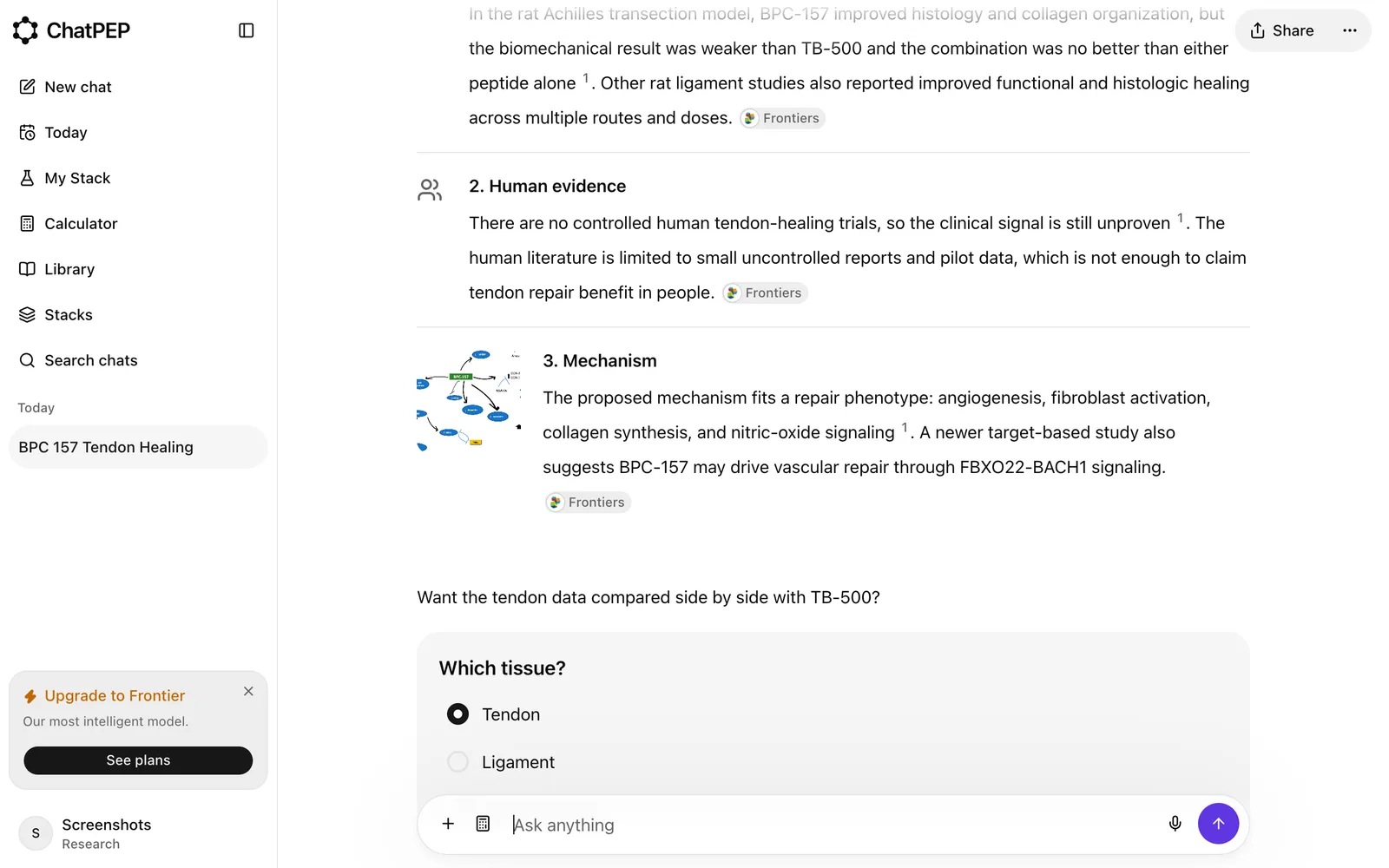
The written answer opens with a bold short answer, and longer answers number their findings and place source chips at the ends of sentences 2. ChatPEP cites published studies, registered clinical trials, and web pages 1. That means the answer is not floating free. Each claim with a number can be followed to a page you can read.
On the web, you can select the Sources button under the answer and keep the panel open while you scroll 1. On iPhone and Android, you tap the book button with the number of sources 1. The point is the same across devices: the answer's evidence is visible, and it is separated from the answer's wording.
The line under the message box says ChatPEP can make mistakes and to check important info 3. That is not a weakness in the citations. It is the same rule that applies to any source: open the study and read what it actually did.
What a source cannot do for you
A citation is a starting point, not a substitute for reading. ChatPEP reports what studies did and what they found, and describes doses only as studies used them 4. A source can tell you who was studied and what happened. It cannot tell you that the same thing would apply to you, because a study cannot examine you.
Open the source before acting on anything that matters. If the paper is behind a paywall, the citation still names it, so you can look up the abstract (the paper's own summary) or ask a librarian. If the source is a web page, you can read the page yourself. That is the whole point. A cited answer is a map to the evidence, not a substitute for it.
ChatPEP gives you the cited research to bring to a clinician who knows your history 3. The value of a cited answer is that it hands you the raw material. You can read the paper, check the sample, and bring it to a clinician. Confidence cannot be handed over. A source can.
Compound pages
References
Decide what kind of research tool to trust
ChatPEP answers from the studies, with every source cited, and never tells you what to take.
Keep reading
Guide6 min read
How to tell a rat study from a human trial
Most headlines about a peptide hide the species behind the finding. Learn to spot whether a claim rests on a rat study or a human trial, and what each level of evidence can and cannot tell you.
Guide3 min read
What to look for in a research tool for peptides
Six tests any research tool should pass before you trust it: it shows the study, states the evidence level, reports doses without advising, checks your medications, does the math, and remembers what you are researching.
Guide5 min read
Best AI for peptides
A side-by-side look at peptide AI apps from their store listings: which answers cite studies, which give doses, and which check your medications.